Up

Replacing SAP ECC: Deadlines, Reasons, and Planning Certainty

All SAP customers know that support for SAP ERP 6.0 will end in late 2027. What’s more telling, however, is that more than half of the companies surveyed continue to use SAP ECC, usually alongside the new system. A decision made today is therefore neither too early nor too late.

Executives in the conference room reviewing timelines and key metrics for the replacement of SAP ECC; a subdued, navy-blue atmosphere

Key Points at a Glance

The key finding

Extended maintenance postpones the end of support, but it does not eliminate uncertainty. Companies ensure planning certainty by making their own decisions. Those who start now are using an architecture that was not yet available in 2025.

Use of SAP ECC
54% of respondents · 2024: 68%
Routine Maintenance
Ends on December 31, 2027
Renewal Fees
+ 2 percentage points, by the end of 2030
The Biggest Challenge in 2026
Cost-Effectiveness · 79%

What Rules Will Apply Starting in 2027

Three dates are central to the discussion about the end of maintenance. Each represents a different status. These differences affect the calculation.
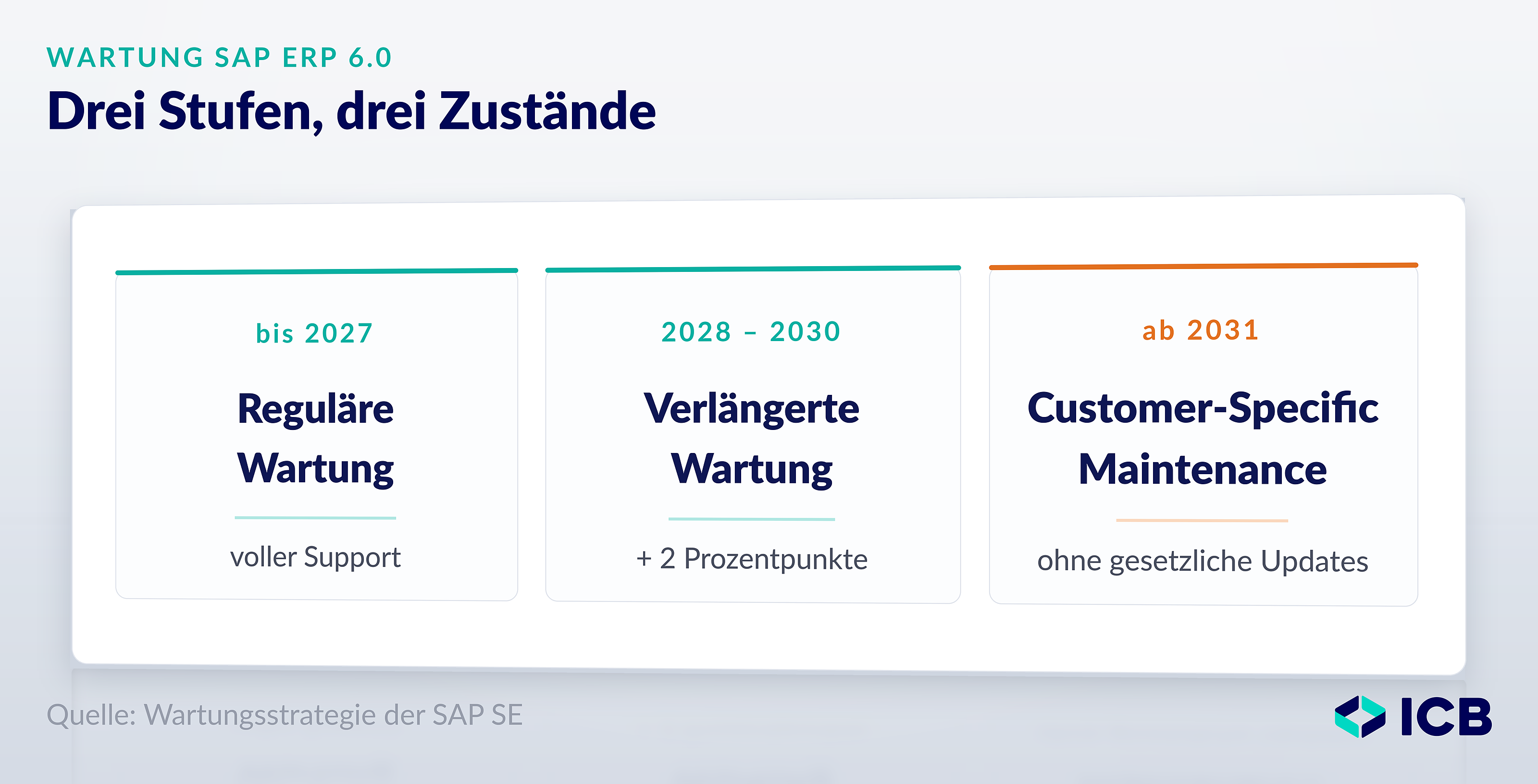
Three cards side by side in a well-lit room: regular maintenance through 2027 with full support; extended maintenance from 2028 to 2030 for a two-percentage-point surcharge; customer-specific maintenance starting in 2031 without mandatory updates
The three levels represent different states. Only Level One does not require a supplementary contract. Graphic: created by the author.

December 31, 2027: End of routine maintenance

Regular maintenance for SAP ERP 6.0 with Enhancement Packages 6, 7, and 8—referred to by SAP as “Mainstream Maintenance”—ends on December 31, 2027. Until then, support also includes mandatory updates. Of the three support levels, only this one is provided unconditionally and without a supplementary contract.

2028 through 2030: Surcharge for extended maintenance

Companies can extend maintenance coverage for 2028 through 2030. To do so, they pay a two-percentage-point surcharge on top of the existing maintenance base. The offer includes only Enhancement Packages 6 through 8 and requires a contract covering the entire affected landscape. Individual systems cannot be selected. The planned extension costs money and is not automatic.

Starting in 2031: No statutory updates in Customer-Specific Maintenance

After that, Customer-Specific Maintenance takes effect. Companies can continue to operate the system, but mandatory updates are no longer provided. Responsibility for compliance then falls on the company. It must implement, test, and justify every change in tax, reporting, or commercial law on its own. For regulated processes, this transition marks a decisive break. Only the “SAP ERP, Private Edition, Transition Option” offers an extension through 2033. It requires a cloud subscription and migration to HANA by the end of 2030. Therefore, anyone counting on 2033 as a buffer must decide on an operating model in advance.

One consequence is often overlooked in the cost estimate: Extending the timeline provides more time but does not create planning certainty. Even after adding two percentage points, decisions regarding the target vision, architecture, and budget are still pending. Only the deadline is pushed back.

Why the problem already exists

The year 2030 isn't the real problem. To begin production by the end of 2030, planning must start today. The timeline is worked backward from the target date.
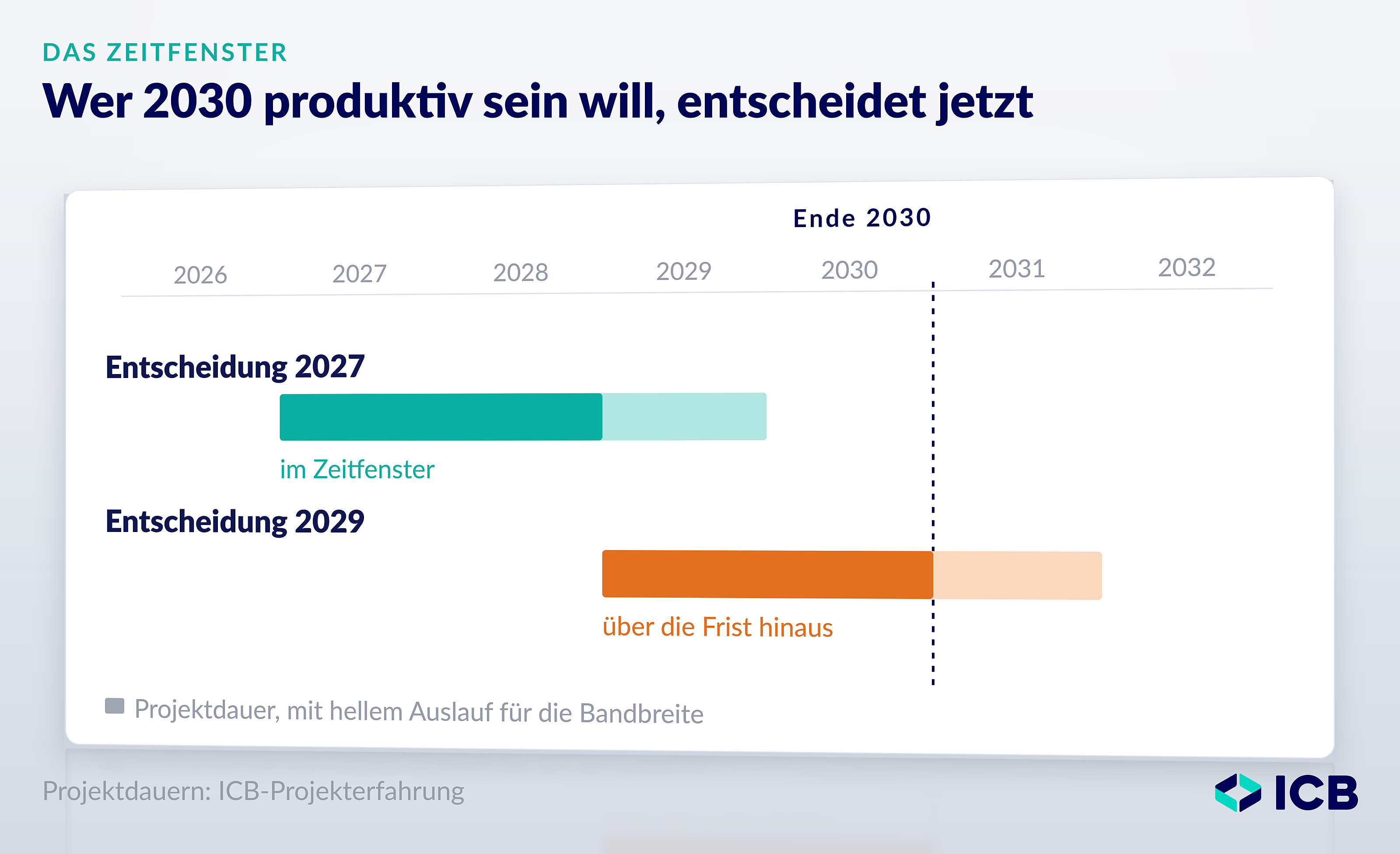
Timeline from 2026 to 2032 in a bright room: A bar starting with a decision made in 2027 ends before the mark at the end of 2030; a bar starting with a decision made in 2029 ends beyond it
If the project duration is the same, only one of the two decision points fits within the available time frame. Graphic: created by the author.

Based on our project experience, an ERP project is typically preceded by 12 to 30 months leading up to the go-live. Its duration depends on the number of locations, subsidiaries, and interfaces. Multiple subsidiaries and locations tend to push the project toward the upper end of the range. Even earlier in the process—in reverse order—come contract negotiations and partner selection, the decision on the system, and the definition of the target overall IT architecture.

Without a clear vision, the effort involved amounts to three years or more: two to two and a half years for the project and one year for preparation. A clear vision significantly speeds up the process. What matters most is clarity before the project begins, not a shorter project duration.

Added to this is a bottleneck that planning alone cannot prevent. All affected companies are migrating within the same time frame. This creates a shortage of experienced consultants, developers, and project managers. This shortage affects deadlines and prices.

This establishes a specific target date rather than a vague “sometime by 2030”: By early 2027 at the latest, it should be clear what needs to be in place by the end of 2028. This includes the overall IT architecture, the system, and the first step. This shortest segment of the chain can be developed in just a few weeks.

Many people face the same challenge and have an opportunity

The DSAG Investment Report 2026 surveyed a total of 198 participants from customer companies between December 8, 2025, and January 21, 2026. According to the report, 54 percent continue to use SAP ECC or the legacy Business Suite. In 2024, that figure was 68 percent. The survey allowed for multiple responses. Running both systems in parallel is common practice.

The ranking of the obstacles reveals the main focus. Cost-effectiveness and economic conditions lead the way, each at 79 percent. License and contract structuring follows at 70 percent. The end of maintenance support comes in at 63 percent. In addition, 62 percent base their investment planning only loosely on—or not at all on—their manufacturer’s vision. This suggests a lack of justification rather than a lack of feasibility.

Starting today, therefore, leads to a different project than starting in 2025. Today, a series of smaller, incremental projects can replace the large monolith. Cloud building blocks and AI functions fit into an architecture that can be expanded later. Under these circumstances, even a decision made later would have made good use of the past few months.

There is a different approach behind this. The target vision is implemented in stages: first the core, then department by department and location by location. Each stage begins independently, generates value, and refines the assumptions for the next step. As a result, value creation begins even before a multi-year program is completed. Risk is also reduced, because individual steps can be adjusted. This is not possible with a large-scale project.

AI accelerates this approach. Based on our project experience, process mapping, fit-gap analysis, test cases, and data migration now require less preparation time than in previous projects. During subsequent operations, assistive functions complement the capabilities of the legacy system. Both of these effects specifically shorten the typically time-consuming phases of an ERP project.

The real-world time pressure is offset by an early-mover advantage. Companies break down large-scale projects into phases, realize benefits sooner, and accelerate their work with AI. This advantage can only be harnessed through a deliberate and timely decision.

Five Reasons for a Lack of Planning Certainty

Based on its project work since 2002, ICB GmbH has identified recurring patterns of delays. Five of these occur almost every time. Each has understandable reasons.
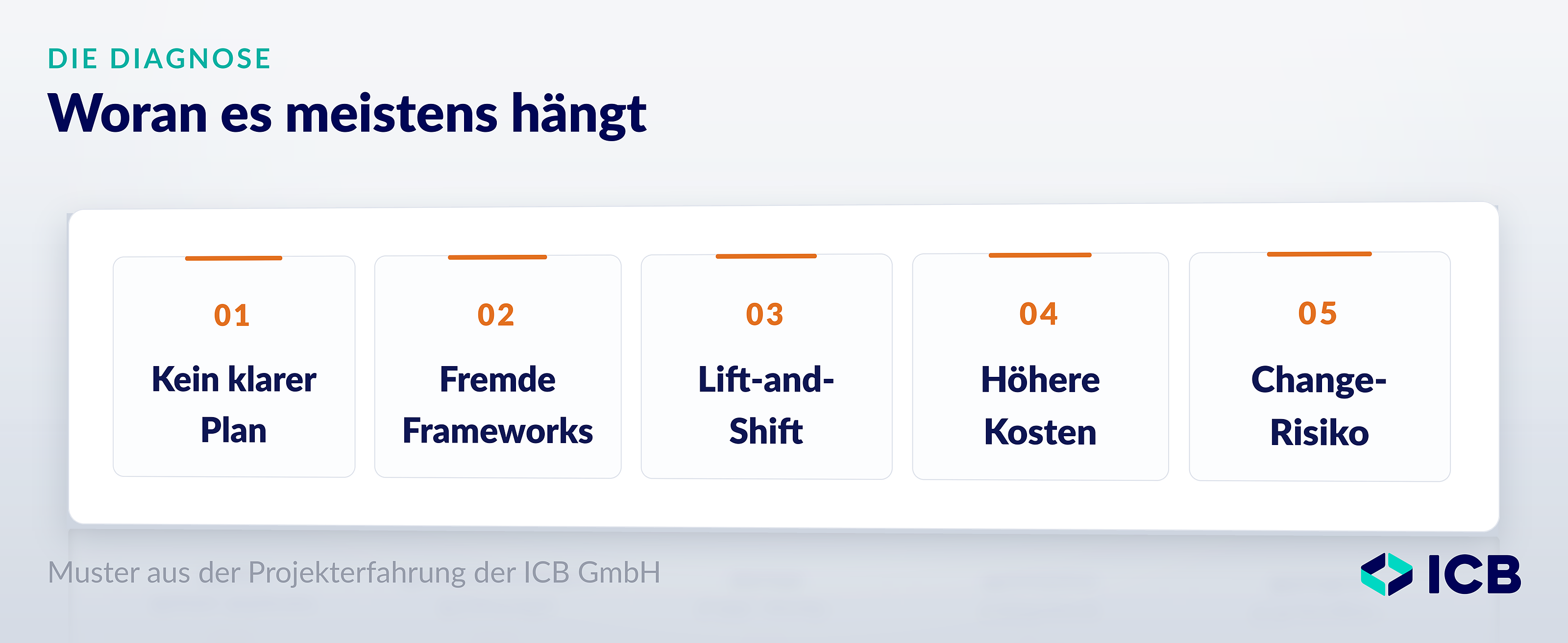
Five cards side by side in a brightly lit room, numbered 01 through 05: no clear plan, third-party frameworks, lift-and-shift, higher costs, change risk
Companies regularly encounter these five patterns in recruitment projects. Graphic: created by the author.

1. SAP and its partners have not presented a clear plan

The portfolio is changing faster than customers' planning cycles. In July 2025, RISE with SAP became SAP Cloud ERP Private. At the same time, SAP introduced a new SKU structure. An offering evaluated in 2024 therefore uses different designations than today's offerings. By extending the maintenance period, SAP has reduced market pressure and provides a documented target platform.

2. Evaluation frameworks guide decision-making

Implementation partners use their own evaluation frameworks. These often answer the question “Private or Public Edition” before the company has even formulated the question itself. This is evident from the criteria that are missing: differentiation processes, intercompany structure, and in-house developments. The frameworks draw on real-world project experience and are not manipulative. However, their evaluation is based exclusively on the deliverable portfolio.

3. Lift-and-shift offers no clear benefits

If the company plans to treat the migration as merely a technical move, the processes will remain unchanged. Nevertheless, the costs will increase.

"I've moved my old processes to a new solution—and now I have to pay even more money."

Manuel Baum, Founder and Managing Director of ICB GmbH

A technical transition can reduce risks as an interim step. If, on the other hand, it is presented as the ultimate goal, it does not support a business case.

4. The cost model is becoming structurally more expensive

The purchased ECC licenses have been depreciated. SAP currently charges only for maintenance, which is adjusted annually based on the consumer price index and capped at five percent. For the cloud, on the other hand, a subscription fee applies. That is why we are comparing a change in model, not a price tag. The only meaningful factor is the total contract term. The subscription covers operations, updates, and infrastructure. These costs also arise in ECC operations, but they are allocated to different budget lines.

5. Change management involves risks

The greatest risk is often assigned the smallest budget. An ERP migration changes the way people work—people who have been proficient in their system for ten or fifteen years. If the project doesn’t involve key users until testing begins, surprise turns into resistance.

Each of the five causes can be addressed with a targeted solution. This doesn't require a large-scale project. A brief, structured analysis will show which approach is right for your situation. We'd be happy to review this with you.

A late start, but the opportunity is still there

Companies using SAP ECC are starting late today. An extended maintenance period eases the immediate pressure, but it does not replace a decision. Despite the two-percentage-point premium, the uncertainty remains. It merely postpones the deadline.

At the same time, today's technical capabilities offer other options. A launch in 2026 or 2027 no longer requires a comprehensive master plan, as would have been necessary in 2025. Instead, an open architecture can be developed in smaller steps.

That is where the opportunity for a late entry lies. The company divides the overall project into phases. Each phase begins and pays for itself sooner. AI accelerates both the preparation and subsequent operation. Thus, a mandatory deadline generates measurable value right from the very first step. To achieve this, planning must begin now.

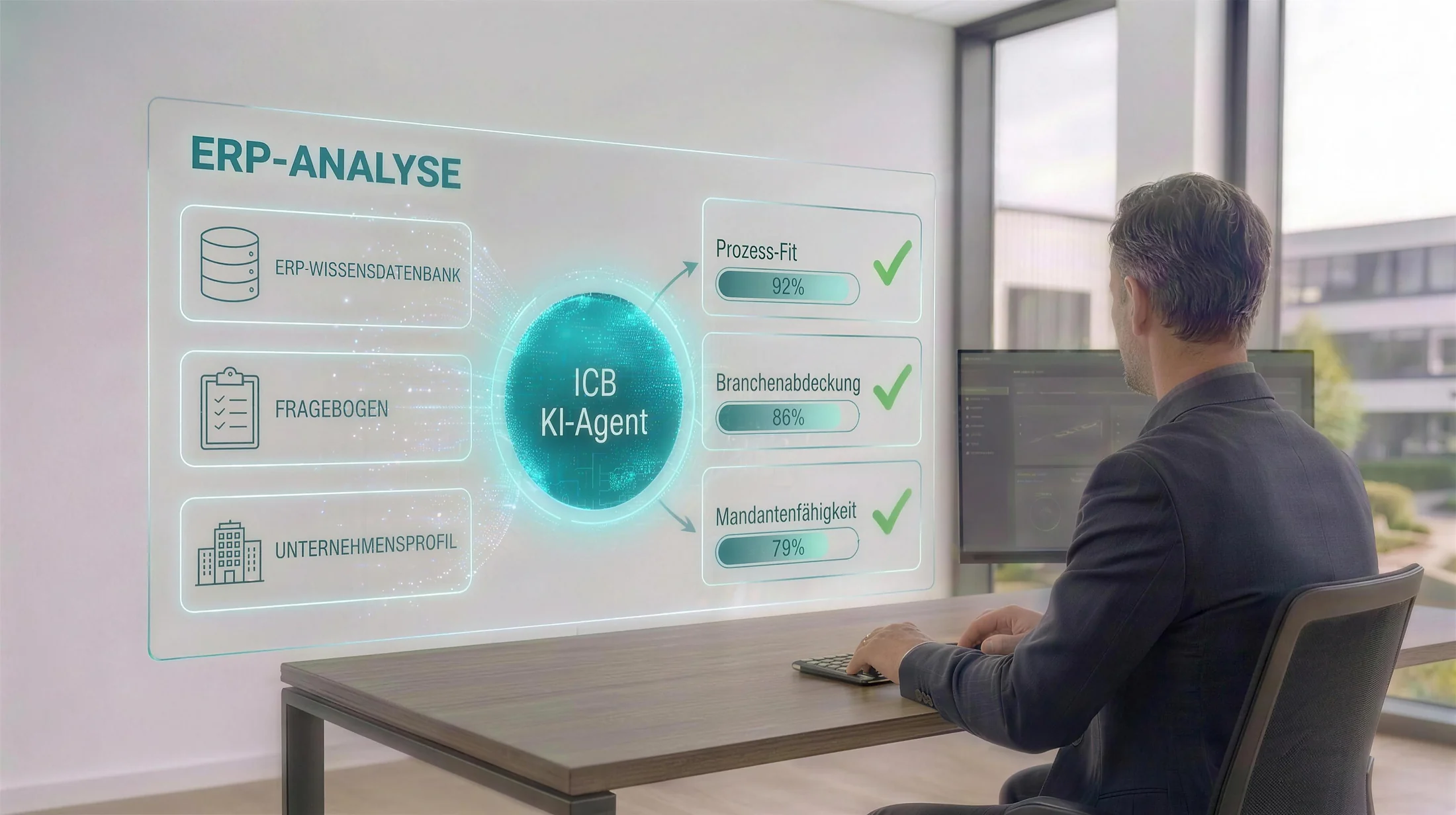
Your free ERP analysis in one to two business days

The six steps take eight to ten minutes, and no registration is required. You’ll receive a vendor-neutral system preselection, processed on EU servers in compliance with the GDPR. ERP vendors do not receive any data. Start your free ERP analysis.

During the ERP consulting appointment, we’ll discuss deadlines, contract terms, and a realistic timeline for your IT landscape.

References

  • German-Speaking SAP User Group e. V. (DSAG): DSAG Investment Report 2026. The press release was issued on February 26, 2026. The survey was conducted from December 8, 2025, to January 21, 2026, and included 198 participants.
  • SAP SE: SAP Support Strategy - Commitments & Extension Programs. The source lists the maintenance periods for SAP ERP 6.0 and Enhancement Packages 6 through 8. It also describes the adjustment of maintenance prices based on the consumer price index and the cap on such adjustments at five percent.
  • SAP SE: In July 2025, SAP changed its portfolio and name. RISE with SAP became SAP Cloud ERP Private. A new SKU structure was also introduced. Source: news.sap.com.
  • ICB GmbH has been gaining project experience in ERP projects since 2002. Project durations and time frames are based on experience and are not actual figures.

ICB GmbH provides management and technology consulting services at its locations in Munich and Gütersloh. Sources verify the third-party key figures cited. The cover image was generated using AI. The three overview charts were created in-house.

To our free 60 min. consultation
Calendar

When

Map

Where

Clock

Agenda

Frequently asked questions

When will support for SAP ECC end?

Down arrow

On December 31, 2027, regular maintenance for SAP ERP 6.0 with Enhancement Packages 6 through 8 will end. For a surcharge of two percentage points on the maintenance base, the entire affected landscape can be extended through the end of 2030. Starting in 2031, Customer-Specific Maintenance will take effect without statutory updates. Only the “SAP ERP, Private Edition, Transition Option” allows for an extension through 2033. This requires a cloud subscription and migration to HANA by the end of 2030.

Does extended maintenance provide planning certainty?

Down arrow

No. Extending the contract merely postpones the end of support, while the uncertainty remains. The surcharge incurs costs. Decisions regarding the target state, architecture, and budget are still pending. Only a basis for decision-making of our own can provide planning certainty. A longer maintenance contract does not achieve that.

By when must a decision be made regarding a 2030 go-live?

Down arrow

Based on ICB’s project experience, it takes 12 to 30 months from the decision to go-live. Added to this is the lead time for defining the target vision and the contract phase. To achieve a go-live by the end of 2030, work should begin now. By early 2027 at the latest, it must be clear what is to be implemented by the end of 2028. A launch without a defined target vision takes three years.

Does the current SAP ECC operation pose any disadvantages?

Down arrow

Not necessarily. A decision made today no longer leads to the large-scale program that was common in 2025. Instead, current cloud and AI building blocks are giving rise to a landscape of smaller projects that build on one another. Each step begins independently and generates benefits sooner. AI reduces the amount of preparatory work. The real-world time pressure is thus offset by a methodological head start.

Is SAP S/4HANA the only option?

Down arrow

No. With SAP S/4HANA, very few questions remain unanswered, since the data model, processes, and history from SAP ECC 6.0 are already known. In addition, the market offers solutions from Infor, Microsoft, Oracle, and open-source providers. The overall IT architecture determines the appropriate option. ICB GmbH does not commit to any specific solution in advance. It does not maintain partnerships with vendors, does not sell licenses, and does not perform implementations itself.

Share article

Table of contents
Want an outside perspective? 45 minutes via Teams—open and honest, no sales pitch.

Key Points at a Glance

The key finding

Extended maintenance postpones the end of support, but it does not eliminate uncertainty. Companies ensure planning certainty by making their own decisions. Those who start now are using an architecture that was not yet available in 2025.

Use of SAP ECC
54% of respondents · 2024: 68%
Routine Maintenance
Ends on December 31, 2027
Renewal Fees
+ 2 percentage points, by the end of 2030
The Biggest Challenge in 2026
Cost-Effectiveness · 79%

What Rules Will Apply Starting in 2027

Three dates are central to the discussion about the end of maintenance. Each represents a different status. These differences affect the calculation.

Three cards side by side in a well-lit room: regular maintenance through 2027 with full support; extended maintenance from 2028 to 2030 for a two-percentage-point surcharge; customer-specific maintenance starting in 2031 without mandatory updates
The three levels represent different states. Only Level One does not require a supplementary contract. Graphic: created by the author.

December 31, 2027: End of routine maintenance

Regular maintenance for SAP ERP 6.0 with Enhancement Packages 6, 7, and 8—referred to by SAP as “Mainstream Maintenance”—ends on December 31, 2027. Until then, support also includes mandatory updates. Of the three support levels, only this one is provided unconditionally and without a supplementary contract.

2028 through 2030: Surcharge for extended maintenance

Companies can extend maintenance coverage for 2028 through 2030. To do so, they pay a two-percentage-point surcharge on top of the existing maintenance base. The offer includes only Enhancement Packages 6 through 8 and requires a contract covering the entire affected landscape. Individual systems cannot be selected. The planned extension costs money and is not automatic.

Starting in 2031: No statutory updates in Customer-Specific Maintenance

After that, Customer-Specific Maintenance takes effect. Companies can continue to operate the system, but mandatory updates are no longer provided. Responsibility for compliance then falls on the company. It must implement, test, and justify every change in tax, reporting, or commercial law on its own. For regulated processes, this transition marks a decisive break. Only the “SAP ERP, Private Edition, Transition Option” offers an extension through 2033. It requires a cloud subscription and migration to HANA by the end of 2030. Therefore, anyone counting on 2033 as a buffer must decide on an operating model in advance.

One consequence is often overlooked in the cost estimate: Extending the timeline provides more time but does not create planning certainty. Even after adding two percentage points, decisions regarding the target vision, architecture, and budget are still pending. Only the deadline is pushed back.

Why the problem already exists

The year 2030 isn't the real problem. To begin production by the end of 2030, planning must start today. The timeline is worked backward from the target date.

Timeline from 2026 to 2032 in a bright room: A bar starting with a decision made in 2027 ends before the mark at the end of 2030; a bar starting with a decision made in 2029 ends beyond it
If the project duration is the same, only one of the two decision points fits within the available time frame. Graphic: created by the author.

Based on our project experience, an ERP project is typically preceded by 12 to 30 months leading up to the go-live. Its duration depends on the number of locations, subsidiaries, and interfaces. Multiple subsidiaries and locations tend to push the project toward the upper end of the range. Even earlier in the process—in reverse order—come contract negotiations and partner selection, the decision on the system, and the definition of the target overall IT architecture.

Without a clear vision, the effort involved amounts to three years or more: two to two and a half years for the project and one year for preparation. A clear vision significantly speeds up the process. What matters most is clarity before the project begins, not a shorter project duration.

Added to this is a bottleneck that planning alone cannot prevent. All affected companies are migrating within the same time frame. This creates a shortage of experienced consultants, developers, and project managers. This shortage affects deadlines and prices.

This establishes a specific target date rather than a vague “sometime by 2030”: By early 2027 at the latest, it should be clear what needs to be in place by the end of 2028. This includes the overall IT architecture, the system, and the first step. This shortest segment of the chain can be developed in just a few weeks.

Many people face the same challenge and have an opportunity

The DSAG Investment Report 2026 surveyed a total of 198 participants from customer companies between December 8, 2025, and January 21, 2026. According to the report, 54 percent continue to use SAP ECC or the legacy Business Suite. In 2024, that figure was 68 percent. The survey allowed for multiple responses. Running both systems in parallel is common practice.

The ranking of the obstacles reveals the main focus. Cost-effectiveness and economic conditions lead the way, each at 79 percent. License and contract structuring follows at 70 percent. The end of maintenance support comes in at 63 percent. In addition, 62 percent base their investment planning only loosely on—or not at all on—their manufacturer’s vision. This suggests a lack of justification rather than a lack of feasibility.

Starting today, therefore, leads to a different project than starting in 2025. Today, a series of smaller, incremental projects can replace the large monolith. Cloud building blocks and AI functions fit into an architecture that can be expanded later. Under these circumstances, even a decision made later would have made good use of the past few months.

There is a different approach behind this. The target vision is implemented in stages: first the core, then department by department and location by location. Each stage begins independently, generates value, and refines the assumptions for the next step. As a result, value creation begins even before a multi-year program is completed. Risk is also reduced, because individual steps can be adjusted. This is not possible with a large-scale project.

AI accelerates this approach. Based on our project experience, process mapping, fit-gap analysis, test cases, and data migration now require less preparation time than in previous projects. During subsequent operations, assistive functions complement the capabilities of the legacy system. Both of these effects specifically shorten the typically time-consuming phases of an ERP project.

The real-world time pressure is offset by an early-mover advantage. Companies break down large-scale projects into phases, realize benefits sooner, and accelerate their work with AI. This advantage can only be harnessed through a deliberate and timely decision.

Five Reasons for a Lack of Planning Certainty

Based on its project work since 2002, ICB GmbH has identified recurring patterns of delays. Five of these occur almost every time. Each has understandable reasons.

Five cards side by side in a brightly lit room, numbered 01 through 05: no clear plan, third-party frameworks, lift-and-shift, higher costs, change risk
Companies regularly encounter these five patterns in recruitment projects. Graphic: created by the author.

1. SAP and its partners have not presented a clear plan

The portfolio is changing faster than customers' planning cycles. In July 2025, RISE with SAP became SAP Cloud ERP Private. At the same time, SAP introduced a new SKU structure. An offering evaluated in 2024 therefore uses different designations than today's offerings. By extending the maintenance period, SAP has reduced market pressure and provides a documented target platform.

2. Evaluation frameworks guide decision-making

Implementation partners use their own evaluation frameworks. These often answer the question “Private or Public Edition” before the company has even formulated the question itself. This is evident from the criteria that are missing: differentiation processes, intercompany structure, and in-house developments. The frameworks draw on real-world project experience and are not manipulative. However, their evaluation is based exclusively on the deliverable portfolio.

3. Lift-and-shift offers no clear benefits

If the company plans to treat the migration as merely a technical move, the processes will remain unchanged. Nevertheless, the costs will increase.

"I've moved my old processes to a new solution—and now I have to pay even more money."

Manuel Baum, Founder and Managing Director of ICB GmbH

A technical transition can reduce risks as an interim step. If, on the other hand, it is presented as the ultimate goal, it does not support a business case.

4. The cost model is becoming structurally more expensive

The purchased ECC licenses have been depreciated. SAP currently charges only for maintenance, which is adjusted annually based on the consumer price index and capped at five percent. For the cloud, on the other hand, a subscription fee applies. That is why we are comparing a change in model, not a price tag. The only meaningful factor is the total contract term. The subscription covers operations, updates, and infrastructure. These costs also arise in ECC operations, but they are allocated to different budget lines.

5. Change management involves risks

The greatest risk is often assigned the smallest budget. An ERP migration changes the way people work—people who have been proficient in their system for ten or fifteen years. If the project doesn’t involve key users until testing begins, surprise turns into resistance.

Each of the five causes can be addressed with a targeted solution. This doesn't require a large-scale project. A brief, structured analysis will show which approach is right for your situation. We'd be happy to review this with you.

A late start, but the opportunity is still there

Companies using SAP ECC are starting late today. An extended maintenance period eases the immediate pressure, but it does not replace a decision. Despite the two-percentage-point premium, the uncertainty remains. It merely postpones the deadline.

At the same time, today's technical capabilities offer other options. A launch in 2026 or 2027 no longer requires a comprehensive master plan, as would have been necessary in 2025. Instead, an open architecture can be developed in smaller steps.

That is where the opportunity for a late entry lies. The company divides the overall project into phases. Each phase begins and pays for itself sooner. AI accelerates both the preparation and subsequent operation. Thus, a mandatory deadline generates measurable value right from the very first step. To achieve this, planning must begin now.

Your free ERP analysis in one to two business days

The six steps take eight to ten minutes, and no registration is required. You’ll receive a vendor-neutral system preselection, processed on EU servers in compliance with the GDPR. ERP vendors do not receive any data. Start your free ERP analysis.

During the ERP consulting appointment, we’ll discuss deadlines, contract terms, and a realistic timeline for your IT landscape.

References

  • German-Speaking SAP User Group e. V. (DSAG): DSAG Investment Report 2026. The press release was issued on February 26, 2026. The survey was conducted from December 8, 2025, to January 21, 2026, and included 198 participants.
  • SAP SE: SAP Support Strategy - Commitments & Extension Programs. The source lists the maintenance periods for SAP ERP 6.0 and Enhancement Packages 6 through 8. It also describes the adjustment of maintenance prices based on the consumer price index and the cap on such adjustments at five percent.
  • SAP SE: In July 2025, SAP changed its portfolio and name. RISE with SAP became SAP Cloud ERP Private. A new SKU structure was also introduced. Source: news.sap.com.
  • ICB GmbH has been gaining project experience in ERP projects since 2002. Project durations and time frames are based on experience and are not actual figures.

ICB GmbH provides management and technology consulting services at its locations in Munich and Gütersloh. Sources verify the third-party key figures cited. The cover image was generated using AI. The three overview charts were created in-house.

Would you like an outside perspective? We’ll assess your current situation—a 45-minute session via Teams, open and without a sales pitch.
Calendar

When

Map

Where

Clock

Agenda

Frequently asked questions

When will support for SAP ECC end?

Down arrow

On December 31, 2027, regular maintenance for SAP ERP 6.0 with Enhancement Packages 6 through 8 will end. For a surcharge of two percentage points on the maintenance base, the entire affected landscape can be extended through the end of 2030. Starting in 2031, Customer-Specific Maintenance will take effect without statutory updates. Only the “SAP ERP, Private Edition, Transition Option” allows for an extension through 2033. This requires a cloud subscription and migration to HANA by the end of 2030.

Does extended maintenance provide planning certainty?

Down arrow

No. Extending the contract merely postpones the end of support, while the uncertainty remains. The surcharge incurs costs. Decisions regarding the target state, architecture, and budget are still pending. Only a basis for decision-making of our own can provide planning certainty. A longer maintenance contract does not achieve that.

By when must a decision be made regarding a 2030 go-live?

Down arrow

Based on ICB’s project experience, it takes 12 to 30 months from the decision to go-live. Added to this is the lead time for defining the target vision and the contract phase. To achieve a go-live by the end of 2030, work should begin now. By early 2027 at the latest, it must be clear what is to be implemented by the end of 2028. A launch without a defined target vision takes three years.

Does the current SAP ECC operation pose any disadvantages?

Down arrow

Not necessarily. A decision made today no longer leads to the large-scale program that was common in 2025. Instead, current cloud and AI building blocks are giving rise to a landscape of smaller projects that build on one another. Each step begins independently and generates benefits sooner. AI reduces the amount of preparatory work. The real-world time pressure is thus offset by a methodological head start.

Is SAP S/4HANA the only option?

Down arrow

No. With SAP S/4HANA, very few questions remain unanswered, since the data model, processes, and history from SAP ECC 6.0 are already known. In addition, the market offers solutions from Infor, Microsoft, Oracle, and open-source providers. The overall IT architecture determines the appropriate option. ICB GmbH does not commit to any specific solution in advance. It does not maintain partnerships with vendors, does not sell licenses, and does not perform implementations itself.

Share article

Close icon