We use cookies to improve and evaluate the content of the website. By clicking "Accept", you agree to the storage of cookies. For more information, please see our privacy policy.
Close icon
Up
Arrange initial meeting
ERP Implementation & Go-Live

ERP Implementation: Driving Digital TransformationTogether with Partners and AI.

We manage your ERP implementation in collaboration with your implementation partner—from setup to hyper-care, leveraging AI wherever it measurably reduces effort.

SPARK® 2.0 is the ideal starting point—but it’s not required. We’ll review your preliminary work and, if necessary, help you complete specific steps before the implementation begins.
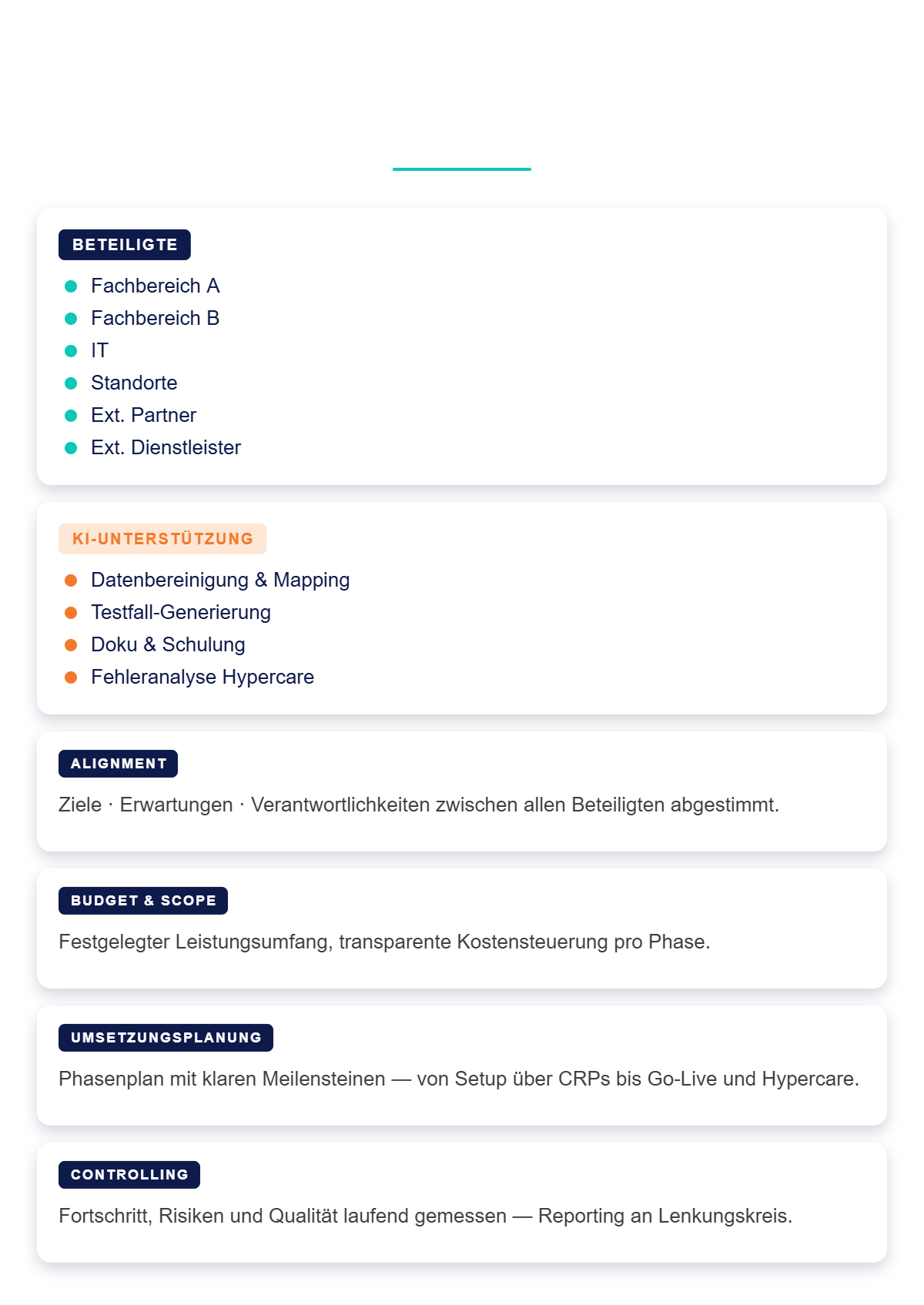

Together with partners
AI in the project
Hyper-Care included
Humboldt Forum LogoImplico LogoGerman Hygiene Museum Dresden LogoSihl Group LogoChristiani LogoHI Wohnbau LogoRiedel Bau LogoAllgäu Battery LogoIPG Automotive LogoFolex Group Logo
WHERE THE INTRODUCTION PICKS UP

The groundwork is done. Now it's time to get started.

The requirements are clear. The system has been selected. The architecture, peripheral systems, interfaces, and data flows have been defined. The project schedule is in place. With all the prerequisites for a smooth implementation now met, the ERP rollout can begin.

Requirements are clear — processes, specifications, and requirements are documented
System selected — the target system has been decided
Architecture and data flows are in place — peripheral systems, interfaces, and client setup defined
Phase plan agreed upon — roll-out option, cutover, cost framework suitable for management
You're in the right place with us, even without SPARK 2.0.

SPARK 2.0 is our structured three-step pre-project process— ERP analysis, ERP selection, and ERP project planning —and the ideal starting point if you want to further refine your maturity level, target system, or phase plan. It is not mandatory.

If you’ve already done the preliminary work, you’ll start right away with the introductory phase. If you still need to catch up on certain modules, we’ll provide you with the specific steps from SPARK 2.0 that you’re missing—or a condensed version that fills in the gap. We’ll assess this during our initial consultation and suggest the best way for you to get started.

PROCEDURE

Six phases — from setup to stable operation.

The Conference Room Pilot (CRP) approach is standard practice for mid-sized ERP projects. It significantly reduces risk because the system is tested against real-world processes multiple times before the go-live date. It is planned on the ERP Project Planning page—and implemented here.

1Project Preparation & InitiationSetup
Project setup, team composition, tooling, governance, and backlog v1. We clarify roles and decision-making processes and define our shared sprint approach. Requirements from the preliminary work are transferred to the backlog and sorted by process, module, and priority—using AI-driven analysis and validated by you.
2Definition — CRP 1Conference Room Pilot 1
Initial end-to-end configuration of the target system across your core processes. We test the standard features, identify areas requiring customization, and define the MVP scope. The result: a fully functional system running on real data and a refined backlog for implementation.
3Implementation — CRP 2Conference Room Pilot 2
Sprint-based implementation: configuration, customization, interfaces, and reports. Sprint reviews with your business units ensure acceptance and quality. AI-generated test data typically speeds up testing by about 30%. Data migration begins as a separate workstream.
4Acceptance — CRP 3Conference Room Pilot 3
Readiness for end-to-end testing. Full-scale data migration, load testing, and interface integration using live data. Training sessions begin, with key users taking on the role of advocates. The mock cutover weekend serves as the dress rehearsal before the actual switchover.
5DeploymentCut-over & Go-live
Final cutover plan, go/no-go gate, switch from the old system to the new one. The rollback strategy keeps the risk low. D-Day proceeds smoothly because all steps have already been tested in the mock cutover.
6Hyper-CareStabilization & Transfer
Intensive stabilization during the first 4–8 weeks after go-live. Ticket triage, correction prioritization, and refresher training. This is followed by a smooth handover to the operational team and the implementation of the AI roadmap during ongoing operations.
AI IN THE INTRODUCTION

For us, AI isn't just a nice-to-have—it's a real game-changer in our projects.

We use AI wherever it measurably reduces effort: backlog, testing, migration. Plus: We incorporate the AI roadmap into our day-to-day operations from day one.

Backlog structuring
Requirements from workshops, emails, and specifications are automatically sorted by process, module, and priority.
Test Data & Test Cases
AI-generated datasets and cases typically speed up the CRP phases by about 30%.
Migration Mapping
Field mappings between the old and new systems are suggested—you verify them instead of searching for them.
Post-Go-Live: Predictive forecasting, intelligent workflows, automated posting processes, AI chatbots for users — implemented step by step, planned from day one.
OUR ROLE IN THE INTRODUCTION

Six areas of responsibility — from Day 1 through to post-launch.

We consistently incorporate these key priorities into every implementation project—regardless of the system or the chosen implementation partner.

Project Management
We manage the backlog, sprint cadence, and delivery sign-offs, drive prioritization, and keep the escalation channel open—both with your partner and within your organization. You receive clear status reports that management and the steering committee can actually understand.
Architectural Authority
We maintain the standard components of the system and only allow customization where your business absolutely requires it. This keeps the system maintainable and upgradeable, and helps keep costs down—both during implementation and in day-to-day operations.
Data migration
Migration is a separate workstream for us—not just a byproduct of CRP 3. We develop the concept and mapping, run several test runs, and import the data in a controlled manner during the cutover. AI helps with field mappings; you verify them.
Cut-over plan
A detailed cutover plan, including a mock cutover over the weekend, a rollback strategy, and a clear go/no-go decision point. This ensures that the go-live is not a black box, but rather a controlled sequence that we have already rehearsed in its entirety.
Training & Adoption
A role-based training program, key user development, and internal advocates—ensuring that the system not only goes live but is also well-received. Recordings and quick guides make getting started each day easier; AI chatbots provide support during the first few weeks.
Hyper-Care Control
During the first 4–8 weeks after go-live: ticket triage, prioritization of fixes, and daily war rooms as needed. We ensure that issues are resolved in a systematic manner—and then hand the system over to the operational team in good order.
OUR APPROACH

We deliver together with our partners—two hands on the wheel.

During the ERP implementation, ICB and our implementation partner work hand in hand. We contribute our expertise in processes, architecture, and management—while our partners bring their in-depth system knowledge and implementation capabilities.

ICB — FOCUS
Control & Architecture
Project Management & Quality Assurance
Backlog, prioritization, escalation
Architectural sovereignty — Ensuring standards
Cut-over plan & data migration
Loyal to your business & management
+
PARTNERS — FOCUS
System & Implementation
System Configuration & Customizing
Interface Development & Reports
Standard configuration & technical depth
Sprint delivery based on the backlog
Preselected by system & industry
BUSINESS IMPACT

What a successful ERP implementation really delivers.

Implementing an ERP system is not just an IT project—it’s the catalyst for your digital transformation and the foundation on which AI can truly take effect. Here are three areas where you’ll see a measurable difference after go-live.

ERP SYSTEM
Processes that actually work.
One source of truth instead of shadow Excel spreadsheets — Sales, Production, and Finance all work with the same numbers.
Faster turnaround times because media breaks and duplicate entries are eliminated.
Scalability for new locations, clients, or business models without disrupting the system.
DIGITALIZATION
Workflows instead of paper trails.
End-to-end processes —from lead to invoice without any system gaps.
Automated workflow: Approvals, postings, and orders are handled based on rules rather than via email.
Real-time visibility into orders, inventory, and liquidity — making decisions based on data rather than gut instinct.
AI SUPPORT
From a system that reports to a system that thinks ahead.
Predictive forecasting for demand, liquidity, and capacity — reliable forecasts instead of Excel estimates.
Smart Workflows: AI classifies, prioritizes, and suggests entries—you review instead of searching.
Chatbots for users reduce the burden on support and accelerate adoption after go-live.
Important: These benefits will only materialize if the implementation is executed properly—with standard procedures, clear guidance, and a roadmap that incorporates AI applications from day one. That is exactly what we offer.
WHY ICB

Four reasons why ICB should lead the implementation.

Brand-neutral
Not tied to any particular system—you can switch partners if necessary.
End-to-end processes
We know where standard features end and customization begins.
ERP + AI + Automation
A methodology for measurably reducing the workload in a project using AI.
Over 20 years serving small and medium-sized businesses
We understand the critical points in mid-market ERP projects.
CHALLENGE

The cost of implementing an ERP system without clear oversight.

Implementations rarely fail because of the software—but rather because of governance, the backlog, the cutover, and hyper-care. We see these six stumbling blocks time and again in medium-sized companies.

Implementation partner with no counterpart
If you manage your implementation partner without a counterpart, you will lose control over the architecture after the first few sprints. The result: uncontrolled customization (system modifications through programming rather than standard configuration), unintended system quirks, and a project that no longer aligns with your business needs but instead follows the partner’s preferences.
Backlog without clear prioritization
Without a clear definition of the MVP (Minimum Viable Product—the core scope that works) and without a clearly prioritized backlog (list of outstanding requirements), every review meeting ends up debating what’s important—instead of delivering results. Sprints get longer, trust from the business units wanes, and the project noticeably loses momentum.
CRP phases are skipped
Anyone who skips Conference Room Pilots or treats them merely as a formality is, in effect, not testing the system until go-live. Vulnerabilities that could be fixed with minimal effort during CRP 1 or CRP 2 become costly problems after go-live.
Data migration as a byproduct
Migration is not a workstream that can be squeezed in just before go-live. A poorly prepared migration will result in incorrect postings, missing metrics, and manual corrections for months after go-live—with all the consequences that entails.
Go-live without a dress rehearsal
Without a mock cut-over this weekend (a dress rehearsal for the switch from the old system to the new one) and without a clear rollback strategy, the actual go-live becomes a gamble. No one knows how long the switch will take, what could go wrong—or what Plan B would even be if the worst were to happen.
Hyper-Care is just a promise
If, after go-live, no one is systematically classifying, prioritizing, and driving tickets, acceptance will plummet within the first 30 days. A project that has been in the works for years can lose its standing within the organization in just four weeks.
INDUSTRIES

Implementation experience across four industries.

We understand the typical implementation challenges in your industry—from standard processes to the areas where customization actually makes sense.

Production & Manufacturing
BOM & Variant Manufacturing
MES & PLM Interfaces
Factory roll-out with client logic
Service Organizations
Project Management & Time Tracking
Resource Planning & Forecasting
Invoice for fixed price & time and materials
construction industry
Trade-specific cost estimation
Construction files, measurements, progress invoices
Supplier & Subcontractor Workflows
Wholesale & Retail
Multi-channel warehouse strategy
Branch & Central Setup
Scheduling, Promotions & EDI Integration
FREQUENTLY ASKED QUESTIONS

Frequently Asked Questions About ERP Implementation.

Answers to the questions we hear before every initial consultation.

Do we need to have completed SPARK 2.0 first?+
No. SPARK 2.0 is the ideal starting point, but not a requirement. We’ll meet you where you are—and assess in advance whether a condensed preliminary project phase makes sense.
How is the implementation partner selected?+
From our partner network—vendor-neutral, with clear evaluation criteria (system expertise, industry, availability, references). Upon request, we can handle the entire selection process.
Who does what—ICB, implementation partners, and us?+
ICB manages the overall project, ensures the customer’s perspective is represented, and maintains discipline through standard procedures. The implementation partner implements the system. You provide subject matter experts, make decisions, and are responsible for process specifications. Responsibilities are defined in a RACI matrix prior to the kick-off.
How long does an ERP implementation typically take?+
For mid-sized companies, the typical timeline is 9 to 18 months from kick-off to the end of the hyper-care phase—depending on the scope, number of clients, and roll-out method (big bang or wave). Reliable figures are provided in Phase 3 of SPARK 2.0; we have summarized the typical phase structure on the project planning page.
What are Conference Room Pilots (CRPs)?+
Realistic testing of the configured system using your data and processes before it goes live. Typically, three CRPs are conducted: functional testing (CRP 1), end-to-end testing with migration data (CRP 2), and a final rehearsal including the cutover (CRP 3). Each CRP identifies vulnerabilities before they become costly problems after go-live.
How do you prevent uncontrolled customization?+
With a strict "fit-to-standard" approach: Every customization request must pass through a decision-making filter—use the standard, configure it, or program it only in justified exceptional cases. We document every decision and ensure that the implementation partner does not slip into the customization comfort zone.
Who is responsible for the data migration?+
We manage the concept, mapping, and test runs—the final migration is carried out in collaboration with our implementation partner. For us, migration is a dedicated workstream, not an afterthought.
What happens after the go-live?+
Hyper-Care: typically a 4–8-week intensive stabilization phase involving ticket triage and refresher training. This is followed by a structured handover to the line.
Are you also handling the AI implementation in the ERP system?+
AI in the implementation project: yes. AI in day-to-day operations (predictive forecasting, chatbots, workflows) is a separate topic that we’ll include in the roadmap after go-live. We’re factoring both into our plans from day one.
How much does ICB support cost?+
Fixed-price components and daily rate components are combined depending on the scope and the selected rollout option. A binding quote will be provided following the free 30-minute initial consultation or as a result of the ERP project planning (Phase 3).
INITIAL CONSULTATION

Ready for the ERP implementation?

In 30 minutes, we’ll discuss your current situation—how far along you are with the preliminary project and partner selection, what phases are coming up, and how we can specifically support you. Free of charge and with no obligation.

Schedule an initial consultation info@icb-gmbh.de