We use cookies to improve and evaluate the content of the website. By clicking "Accept", you agree to the storage of cookies. For more information, please see our privacy policy.
Close icon
Up
Arrange initial meeting
Part of SPARK® 2.0

ERP Selection

Choosing the Right ERP System: Process-Oriented, Architecturally Sound, AI-Tested.

As part of the ICB ERP selection process, we work with you to develop a well-founded recommendation for your target ERP system: ERP market analysis, end-to-end process workshops, precise requirements definition, and a robust target architecture lead to a clear decision. This also constitutes Phase 2 of our SPARK® 2.0 ERP pilot project.

AI-poweredProcess-basedCustomizedVendor-neutral
Humboldt Forum LogoImplico LogoGerman Hygiene Museum Dresden LogoSihl Group LogoChristiani LogoHI Wohnbau LogoRiedel Bau LogoAllgäu Battery LogoIPG Automotive LogoFolex Group Logo
WHAT YOU GET

Four concrete results—at your fingertips once you’ve completed your ERP selection.

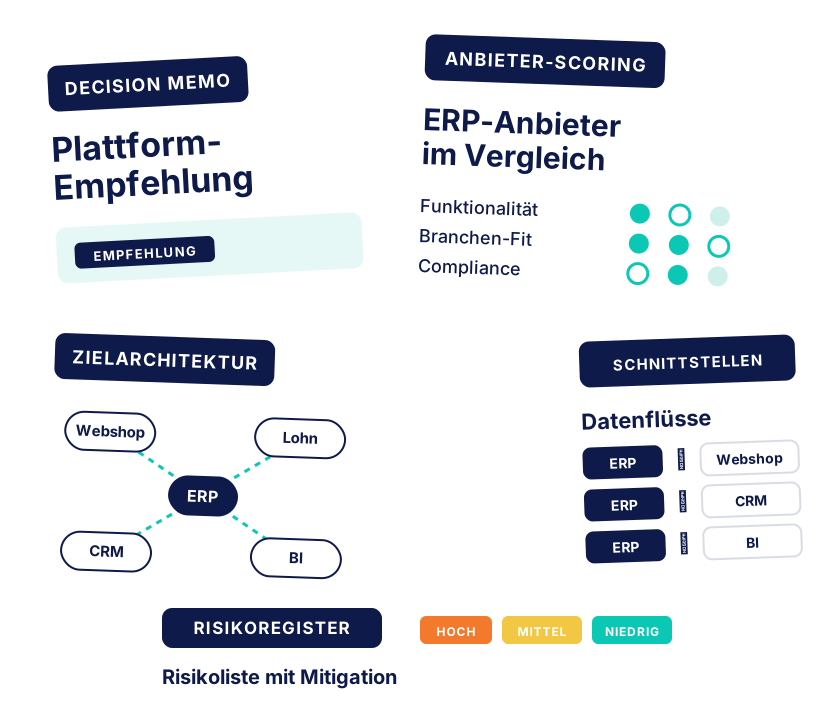
Management Decision Memorandum

Recommendations, cost-effectiveness, risks, and project plan—condensed into a concise format and presented in a way that is accessible to management.

Process map

Detailed requirements for each end-to-end process (functional, technical, strategic), weighted and prioritized.

Target Architecture (Target)

Architecture diagram with data model, interface strategy, and migration path — ready for ERP project planning.

Recommended Targeting System

A target system featuring a brief overview, a "fit-to-standard" assessment, and a concrete proposal for integration into ERP project planning.

PROCEDURE

8 modular steps to the target system.

1
Kick-off & Scope
Joint kick-off meeting with management and the project team: vision, scope definition, success criteria, and timeline. We align workshops and responsibilities—before we even touch the first tool.
Project CharterVision & ScopeWorkshop Plan
2
Information gathering
A structured assessment of existing documentation, systems, and stakeholders. AI agents simultaneously analyze process documents, organizational charts, and interfaces, allowing the workshops to focus on what matters most.
Document InventorySystem MapStakeholders
using AI
3
End-to-End Process Workshops
Mapping of end-to-end processes with the business departments—one workshop per department. Discussion of target processes based on preliminary AI findings, rather than a several-week-long assessment of current processes.
Process MapRequirements CatalogConceptual Sketches
using AI
4
Requirements Specification
Documentation of functional, technical, and strategic requirements for each process. We evaluate and prioritize these requirements—AI agents assist with classification, gap analysis, and consistency checks.
Functional RequirementsTechnical RequirementsStrategic requirements
using AI
5
Analysis of Peripheral Systems & Interfaces
A structured assessment of your existing peripheral systems, interfaces, and data flows. We map dependencies and identify systems suitable for consolidation or migration.
System MapList of InterfacesData Flow Diagram
using AI
6
Fit-to-Standard Analysis
Mapping of the defined requirements and architecture against the standard features of modern cloud ERP platforms. Each requirement is classified as: Fit, Config, Custom, or Gap. AI accelerates the mapping process and identifies opportunities for standardization.
Fit-to-Standard AssessmentStandardization PotentialCustomization Effort
using AI
7
Target Architecture Design
Design of a sustainable long-term target architecture—including a data model, integration strategy, and migration path. AI supports pattern recognition in architectural decisions.
Target ArchitectureMigration pathRisk Assessment
using AI
8
Recommendation for the target system
A well-reasoned recommendation for a target system, including a brief profile, a "fit-to-standard" assessment, and a concrete proposal for integration into the ERP project plan—a decision-making document suitable for management.
Target System RecommendationDecision MemoHandover to Project Planning
using AI
FEEDBACK FROM PROJECTS

Other small and medium-sized businesses have already done it.

Martin Blom
With ICB as a reliable partner, our expectations were exceeded. We were particularly impressed by their focus on standards.
Martin Blom
Chief Financial Officer, Sihl Group
OUR APPROACH

Three guiding principles we use to address common challenges.

Standard First

We start with the best practices of modern cloud ERP platforms—not with your legacy processes. This reduces customization costs and ensures the system can be easily updated.

Cloud Platform First

We evaluate only cloud platforms with a clear roadmap. You’ll end up with an architectural choice that will still be viable in five years.

AI Automation First

AI isn't just a marketing buzzword—it's a selection criterion. For every provider, we assess: What is production-ready, what is on the roadmap, and what is merely a demo?

FIT-TO-STANDARD

We start with the standard version—and customize only what’s really necessary.

Fit-to-Standard is the backbone of our methodology: Every requirement is classified before we decide what actually needs to be custom-developed.

Classification
Meaning
Fit
The standard meets the requirement directly—no adjustments are necessary.
Config
Can be disabled via configuration — without modifying the code, and fully updatable.
Custom
A genuine upgrade is needed—we assess the effort involved, the ability to update, and the risks.
Gap
Functional gap — Determine in advance whether a workaround or a process change is needed.
Your benefits
  • Maintain the ability to update
    Standard components are automatically kept up to date and benefit from every release.
  • Lower TCO
    Less custom code means less maintenance, fewer tests, and fewer surprises over the course of five years.
  • Faster time-to-value
    The standard first approach shortens implementation times and reduces project risk.
  • Clear investment security
    You know exactly what is standard, what is configured, and what is custom—with a cost estimate for each category.
CHALLENGE

Why choosing an ERP system without a structured approach can be costly.

Any company that embarks on an ERP selection process without a clear strategy will waste time, money, and bargaining power. We see these six pitfalls in nearly every small-to-medium-sized business:

Unclear scope of requirements

Functional, technical, and strategic requirements—how deeply do you need to delve to make a sound decision without getting bogged down in details?

High decision uncertainty

An ERP decision commits you for 7 to 10 years. The wrong system will hinder your growth, cost millions in follow-up investments, and be difficult to correct.

Internal resource shortage

Their departments are busy with day-to-day operations and don't have the capacity to conduct a structured evaluation of vendors.

Lack of basis for decision-making

Without a documented assessment of target processes, architecture, and TCO (Total Cost of Ownership), management lacks the basis for making a sound investment decision.

AI capabilities are difficult to assess

Every vendor touts AI—whether it’s production-ready, in beta, or just a slide, it’s impossible to tell the difference from the demo.

Competitive pressure

Your competitors are already going digital. If you take too long to evaluate your options, you’ll lose momentum and market share—every week you lose shrinks your lead.

CONSULTING PATH IN THE SPARK 2.0 ERP PRE-PROJECT

What happens next after selecting an ERP system.

The ERP selection process concludes with the recommendation of the target system. Those who are already thinking about implementation can move directly to Phase 3: ERP project planning. Following that, we will support you through the ERP implementation, working together with our partners if you wish.

1
GET STARTED

ERP Analysis

Vendor-neutral market analysis featuring a weighted criteria set and a well-reasoned recommendation of 2–4 ERP systems — your basis for making an informed decision when selecting an ERP system.

1–2 weeks1 workshop
2
NEWS
IN-DEPTH

ERP Selection

In-depth analysis of the preferred systems, including detailed functional and technical requirements, as well as structured discussions with vendors — to determine your target system.

3–4 weeksDeep-dive workshops
3
PROJECT PLANNING

ERP Project Planning

Development of the target architecture, implementation plan, and robust business case including TCO—ready for management approval.

1–2 weeksManagement template
Following SPARK 2.0: If you’d like, we’d be happy to assist you with the ERP implementation as well.
FREQUENTLY ASKED QUESTIONS

Frequently asked questions before the initial consultation.

How long does an ERP preliminary project take?+
Typically 3 to 4 weeks from kick-off to the recommendation of the target system—depending on the selected scope (number of areas, depth of processes). This is made possible because seven of the eight steps are AI-supported: we parallelize document evaluation, requirement classification, fit-to-standard mapping, and architecture recognition using agents while the workshops with your business units are taking place.
How much time will this take my team?+
One 2–3-hour workshop per department, plus a document handover in advance. The AI preliminary findings significantly reduce the time and effort typically required for the initial assessment.
Will this work even if we already have an ERP system?+
Yes. If you already have an ERP system in place, we use the current situation as a starting point and assess whether migration, optimization, or an add-on is the most cost-effective approach. If you want to move directly to implementation, the next step is the ERP rollout.
What role does AI play in the process?+
AI agents accelerate seven of the eight steps: document analysis, requirement classification, fit-to-standard mapping, architecture identification, and initial document drafting. Consultants synthesize and contextualize the information—the responsibility remains with humans.
Is the result truly independent of the manufacturer?+
Yes. We have been vendor-neutral since 2003 and do not receive commissions from ERP providers. Recommendations are based solely on documented criteria.
What data is collected—and how is it protected?+
We collect only process and requirement data—no personal or business-critical information. Processing is GDPR-compliant and takes place on servers in the EU (Germany available upon request) and is subject to an NDA. The AI models used are not trained using your data.
What do we get at the end of the ERP selection process?+
A well-defined set of objectives, a documented evaluation matrix with a weighted list of criteria, an end-to-end process map with a "fit-to-standard" assessment, and an initial target architecture. This allows you to proceed directly to ERP project planning (Phase 3)—or to use it as the basis for a separate request for proposals.
How much does a preliminary project cost?+
Fixed price based on scope—depending on company size, the number of departments and locations, and the complexity of your process landscape. Estimated cost for small and medium-sized businesses: mid- to high-five-figure range. You’ll receive a binding quote following a free 30-minute initial consultation—transparent, with no hidden costs and no further obligation.
INITIAL CONSULTATION

Ready to choose an ERP system?

In 30 minutes, we’ll discuss your current situation and which specific steps in the ERP selection process make the most sense—processes, requirements, architecture, or the entire package. Free of charge and with no obligation.

Schedule an initial consultation info@icb-gmbh.de