ICB GmbH, based in Munich, provides vendor-neutral support to companies in the process industry with ERP selection and implementation. In the chemical, food, and pharmaceutical industries, three requirements distinguish these systems from one another: batches spanning multiple production stages, formulations with varying active ingredient content and yields, and production at multiple sites. Quality and compliance, on the other hand, distinguish the systems less than the partners who implement them.
How does the process industry approach ERP differently?
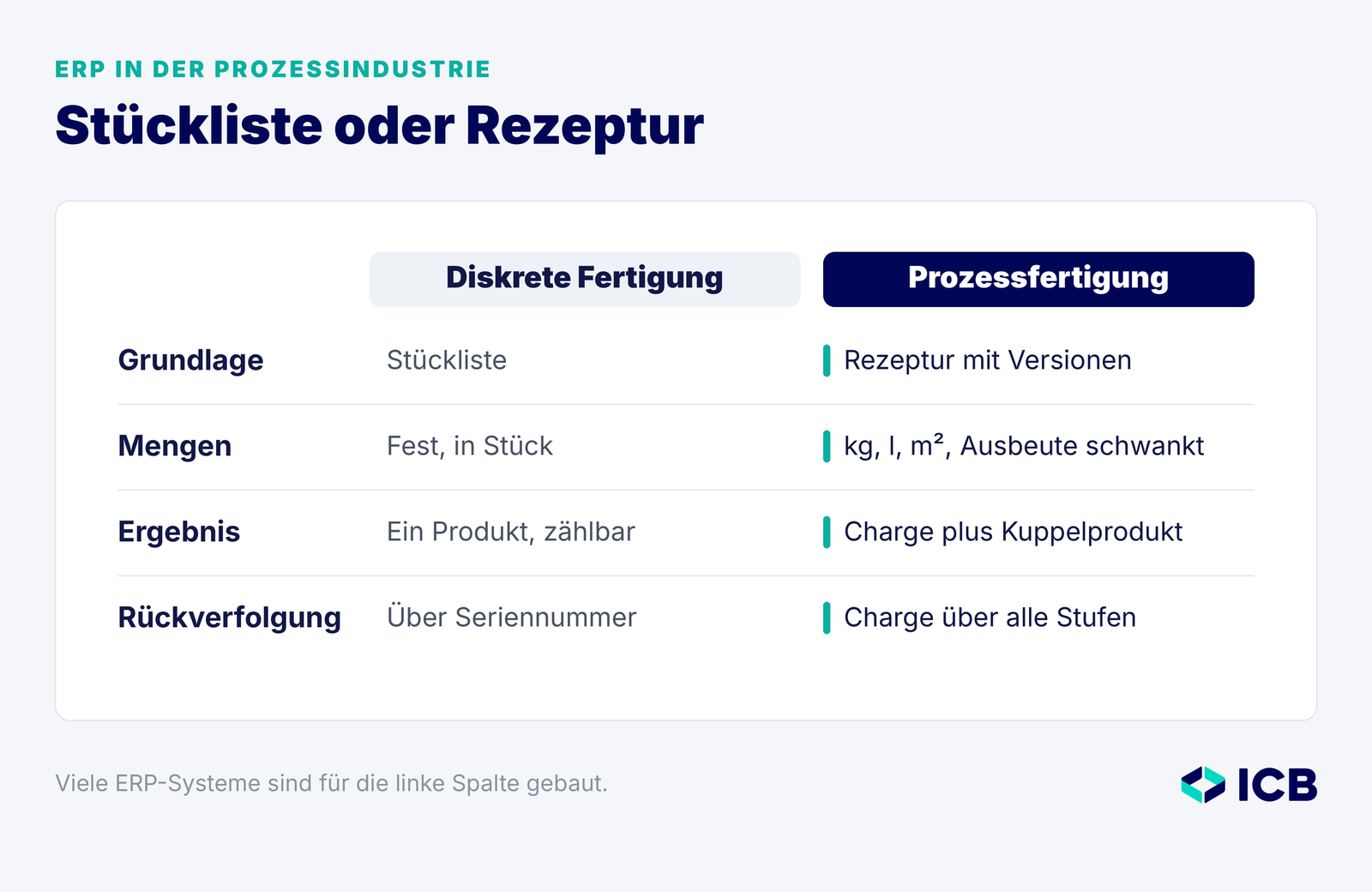
In discrete manufacturing, a bill of materials specifies which parts go into a product; the result can be counted. In the process industry, the process begins with a recipe, and the final output isn't known until after the batch is produced.
For an ERP system, this is a different calculation logic—not a variant of the bill of materials. The quantity used depends on the active ingredient content of the batch currently coming out of inventory. The batch size is determined by the reactor: An order for 1,400 kilograms results in three batches of 500 each. Several products are produced from the same batch, and their costs must be allocated. An item is tracked in two quantities simultaneously: The customer orders 20 cartons, but 203.4 kilograms are billed.
Systems designed for discrete manufacturing model this process indirectly. The byproduct is accounted for as a negative quantity, the active ingredient content is entered into a text field, and the second unit of measure is determined using a conversion factor. Each of these workarounds works well in a presentation, but none of them holds up during the first inventory check, when kilograms and containers must match up side by side.
What ERP requirements are driving the segmentation of the market in the process industry?
When asked, “Can you handle batches?” every vendor answers, “Yes.” You won’t get any further until you describe the specific situation where you regularly run into problems and have them demonstrate how the system handles it.
Batches When Goods Are Returned
Every system shows you the batch number of a finished product; the difference only becomes apparent when goods from a blocked batch are returned, reprocessed, and end up in two other products. The key factor then is whether the recall list is available as a single report or whether someone has to compile it from three separate reports on a Friday afternoon.
Active ingredient content, yield, byproduct
This is where it becomes most clear whether a system was built for process manufacturing. If you give the vendor a batch containing 35 percent active ingredient instead of the planned 30 percent: Does the system automatically recalculate the amount to be used, adjust for the balancing agent, and top off the batch size with filler, or does an employee do the math in their head? The byproduct also requires its own output with its own cost allocation rather than a corrective journal entry.
Multiple locations and countries
This requirement is most often underestimated because it doesn’t cause any problems for anyone during the selection phase. Plant A produces a batch; Company B sells it. Does Company B see the same batch with its history, or does a new lot get created during transfer, causing the chain to break at the company boundary? Added to this are intercompany settlements, consolidated financial statements that exclude internal shipments, and the same formula, which must be labeled differently in each country.
You should therefore have the recall demonstrated across company boundaries rather than within a single plant.
From our project experience: It’s rarely the list of features that tips the scales, but rather the phrase “We’ll handle that in the project,” which comes up in every demo. When it comes to batches, formulas, and multiple locations, it comes up with varying frequency, and that’s how you can tell the systems apart. When it comes to quality and compliance, it comes up just as often everywhere.
Chemicals, Food, Pharmaceuticals: What Each Industry Requires in Addition
The three requirements listed above apply to the entire process industry; the obligations specific to individual sectors come on top of that. For these sectors, the question is rarely whether a system can meet them, but rather whether the partner has already demonstrated compliance.
ERP in the Chemical Industry
Safety data sheets, hazardous substance labeling in accordance with GHS and CLP, REACH registrations, and the shipment of hazardous materials—plus packaging ranging from cans to tanker trucks. An ERP system for the chemical industry must either manage this data itself or transfer it to a specialized system.
ERP in the Food Industry
Best-by dates and use-by dates govern inventory withdrawal and shipping; allergens and nutritional information must be included on the label based on the recipe. For meat, cheese, or fruit, variable weight is an additional consideration, and traceability one step forward and one step back is required by law.
ERP in the Pharmaceutical Industry
Manufacturing in accordance with GMP, a complete audit trail, electronic signatures, and—depending on the product—serialization and validation of the system itself. This validation takes place during the project rather than in the product itself, which is why the choice of implementation partner is more critical here than the choice of system.
Films, Paper, Coatings, and Building Materials
Even companies that coat, extrude, or mix produce according to formulas. Added to this are rolls and formats, offcuts and leftover quantities, square meters, and running meters as units of measure. These companies fall outside the scope of industry classifications but require the same process manufacturing in their ERP systems as a chemical plant.
Industry-Specific ERP, Platform, or Industry Solution: Which Approach Is Right for the Process Industry?
There are three paths to the goal, and they differ less in terms of manufacturing functions than in everything else: finance, country-specific versions, interfaces, available partners, and the question of who will continue to develop the system in ten years. Across this broad spectrum, the major platforms are ahead—more so than their feature lists would suggest.
| Criterion | Industry-Specific ERP for the Process Industry | Large Platform | Industry-Specific Solution on a Single Platform |
|---|---|---|---|
| Discrete Manufacturing | Designed from the start to reach all the way into even the smallest nooks and crannies | Separate functional area in SAP S/4HANA or Microsoft Dynamics 365 Finance & Supply Chain Management: formula, production order, co-product, active ingredient content, secondary unit of measure | Extending a partner, for example, to Microsoft Dynamics 365 Business Central |
| Finance, Group, Countries | Often the weakest link; consolidated financial statements are frequently prepared using a second system | Multiple Companies, Currencies, Country Versions, and Consolidation in the Standard System | The platform's financial services, but the expansion is not available in every country |
| Environment and Partners | Each interface is built individually; there are few partners, and experts are hard to find | CRM, analytics, and AI from the same product family; many partners; predictable releases | Platform environment; a single provider for the expansion |
| Wins if | One location, one country, highly specialized manufacturing | Multiple locations, multiple countries, growth, or affiliation with a corporate group | industry expertise is required and the platform is already in place |
That doesn’t mean an industry-specific ERP system is the worse option; it has the edge when industry-specific depth takes precedence over everything else. Clients who manufacture in multiple countries, need to prepare consolidated financial statements, or want their business to look different in five years than it does today almost always opt for the platform in our projects and then specifically add industry-specific depth as needed.
For companies using SAP ECC 6.0, SAP S/4HANA is therefore an obvious candidate—but it is just one option. We do not provide consulting on the SAP migration itself, but rather on the decision leading up to it.
How does a preliminary ERP project work in the process industry?
SPARK® 2.0 is ICB GmbH’s ERP preliminary project: It brings together market analysis, system selection, and project planning in three phases and seven steps, culminating in a decision-making proposal after just a few weeks. AI agents handle the research in 6 of the 7 steps and evaluate each requirement for every vendor using the same criteria; each evaluation is then approved by a consultant.
For the process industry, this means: Evaluations are based on your own workflows, not on a pre-prepared demonstration. The vendors on the shortlist are presented with exactly the scenarios described above and must demonstrate them within the system. It becomes clear—before any money is spent—which of these scenarios can only be achieved with an in-house solution.
- List of criteria with weightings, industry-specific requirements, and disqualification criteria listed separately
- Market analysis with a long list and short list of industry ERP systems, platforms, and industry solutions
- Fit-to-Standard analysis for the preferred option and cost estimate as 5-year TCO
- Phase-by-phase plan for the rollout across all locations and decision-making proposal for management and the advisory board
The time required for your departments remains between 2 and 3 hours per department, and all deliverables become your property. We do not sell licenses and do not receive commissions from ERP vendors; billing is based on actual time spent, regardless of which system is selected. Learn more about the process on the SPARK® 2.0 ERP Pre-Project page.
From Real-World Experience
Folex Group, Film Production
Following SAP's end-of-life announcement, the Folex Group needed a robust ERP solution, which was developed as part of the SPARK ERP pilot project.
Film Manufacturer, Contract Manufacturing
Migration from SAP ECC 6.0 to Microsoft Dynamics 365 Finance & Supply Chain Management, supported by ICB.
“We were particularly impressed by the focus on standards.”
Martin Blom, CFO, Sihl Group
You can find more projects from the process industry and other sectors in our references.
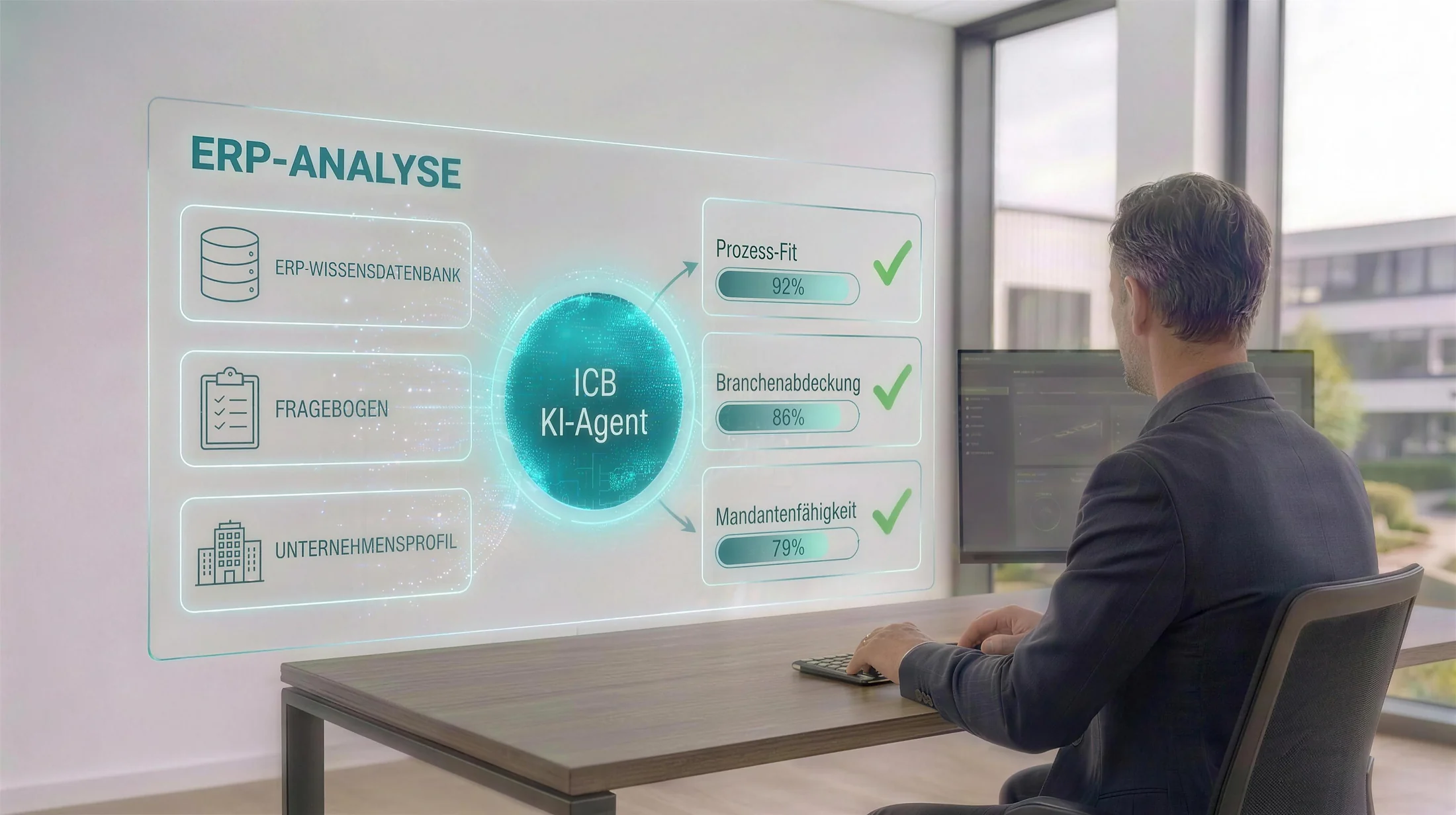
The free online ERP analysis provides an initial, vendor-neutral shortlist of 2 to 4 systems after you complete an 8- to 10-minute questionnaire—via email and without requiring registration.
The cover image was generated by AI. The comparison of the bill of materials and the recipe is a representation created by ICB GmbH.