


Customer Success Story
A custom manufacturer with its own software development team implemented a new ERP system in 11 months: the project began in January 2025, and Microsoft Dynamics 365 Finance & Supply Chain Management went live on January 1, 2026. The system was implemented by ICB GmbH with a team of 6 to 8 consultants.
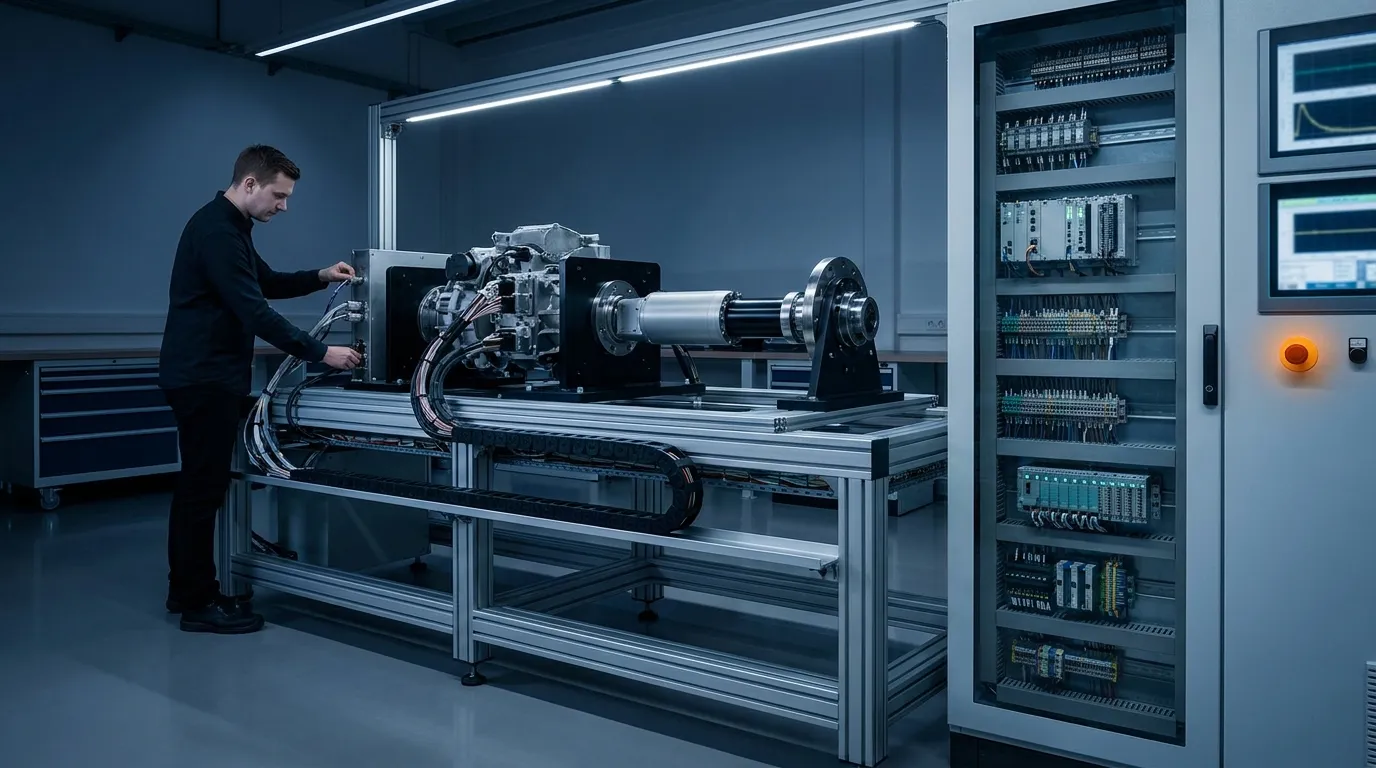
The customer combines two business models under one roof: software development—that is, research and development as a separate process—and a manufacturing business in which complex technical systems are built to customer specifications. Each of these systems is one-of-a-kind, making this a classic example of custom manufacturing. Both business models had to be integrated into a single system. The system was first implemented at the main location in Germany, with other locations to follow later.

Inventory counts based on visual inspection rather than the system: the situation that the project resolved. Image: AI-generated.
An ERP system was already in place, but its implementation had effectively failed. The processes had not been set up properly or thought through from start to finish, and the data structures had not been properly migrated. As a result, there was no robust foundation for processes and data. The consequence: The system was used only in a rudimentary way. Warehousing, logistics, and production largely operated independently of it. Inventory was assessed by visual inspection rather than through the system, and material requests were made verbally or by phone. The ERP system was used primarily to retroactively record events that had long since taken place. This is a pattern we recognize from our projects: It is not the technology that fails, but the process and data work that precedes it. Therefore, a simple fix was not an option; instead, a fresh start on a new platform was necessary.
The decision on the system had already been made at the start of the project; it was the result of a prior ERP selection process. The focus here was on implementation. The scope encompassed the entire ERP core: all end-to-end processes across all departments, including all interfaces and peripheral systems. In addition, there were two integrations: The customer had recently implemented Microsoft Dynamics 365 Sales, and integration between CRM and ERP was required in virtually all processes. An existing service system—not from Microsoft—was integrated without mapping service processes in the ERP. The target date of January 1, 2026, was set from the outset and served as the overarching framework against which the entire approach had to be aligned.
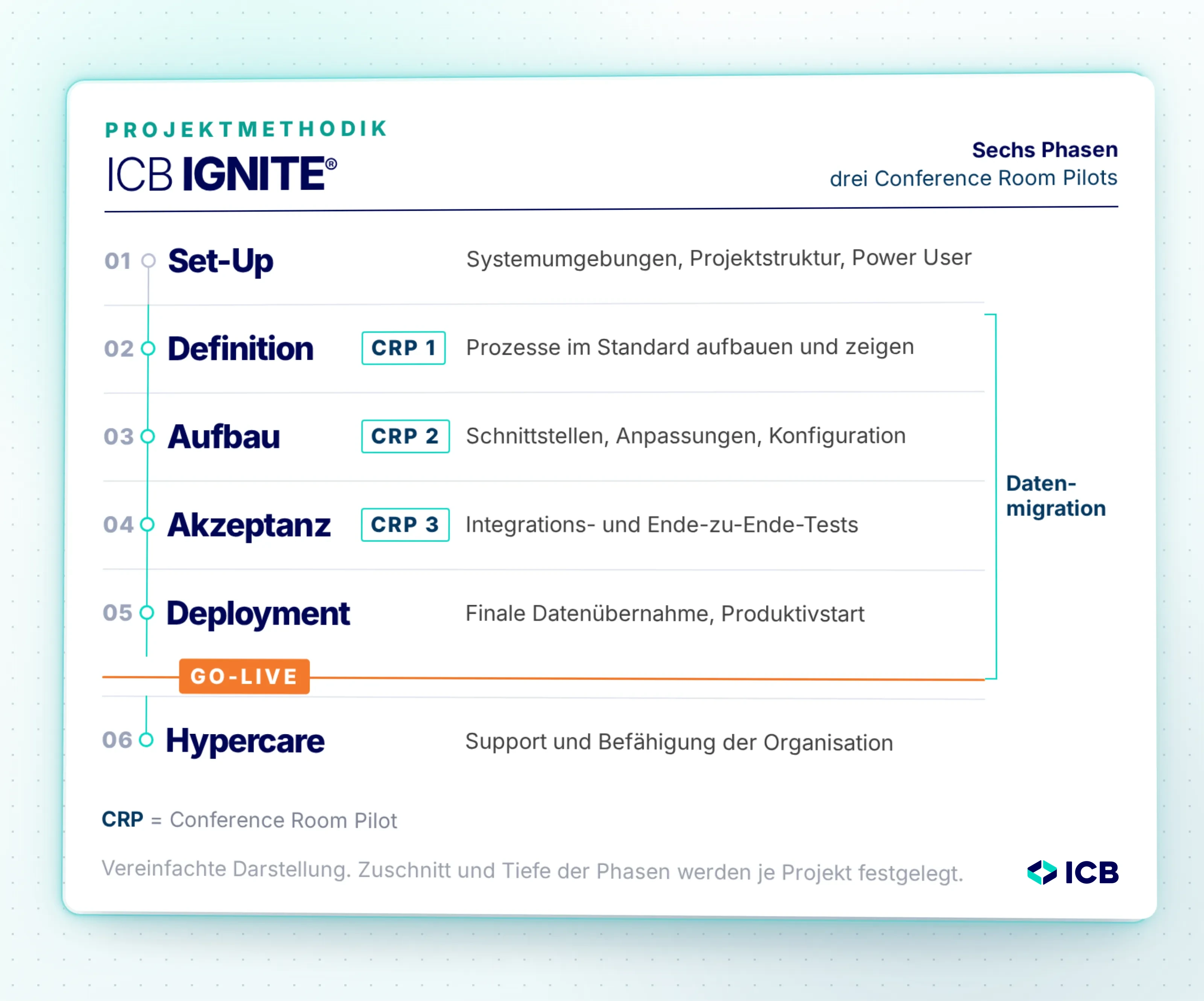
Completing a full ERP core in eleven months is only possible if the methodology and the team are a good fit. We set up the project according to our process model for ERP implementation and deliberately kept the team small: 6 to 8 consultants, with one expert per end-to-end process. The ICB IGNITE methodology is driven by three “conference room pilots”—that is, sessions in which business units and consultants jointly build and run through the processes in the system, rather than describing them on paper. The second key factor was the sequence: All end-to-end processes were first consistently developed using the standard Dynamics 365 Finance & Supply Chain Management configuration and were demonstrated in their entirety. Only then did the business units identify where further customization would add value. Rather than discussing things theoretically, decisions were made based on the live system: This saves time, keeps the team small, and reduces costs.
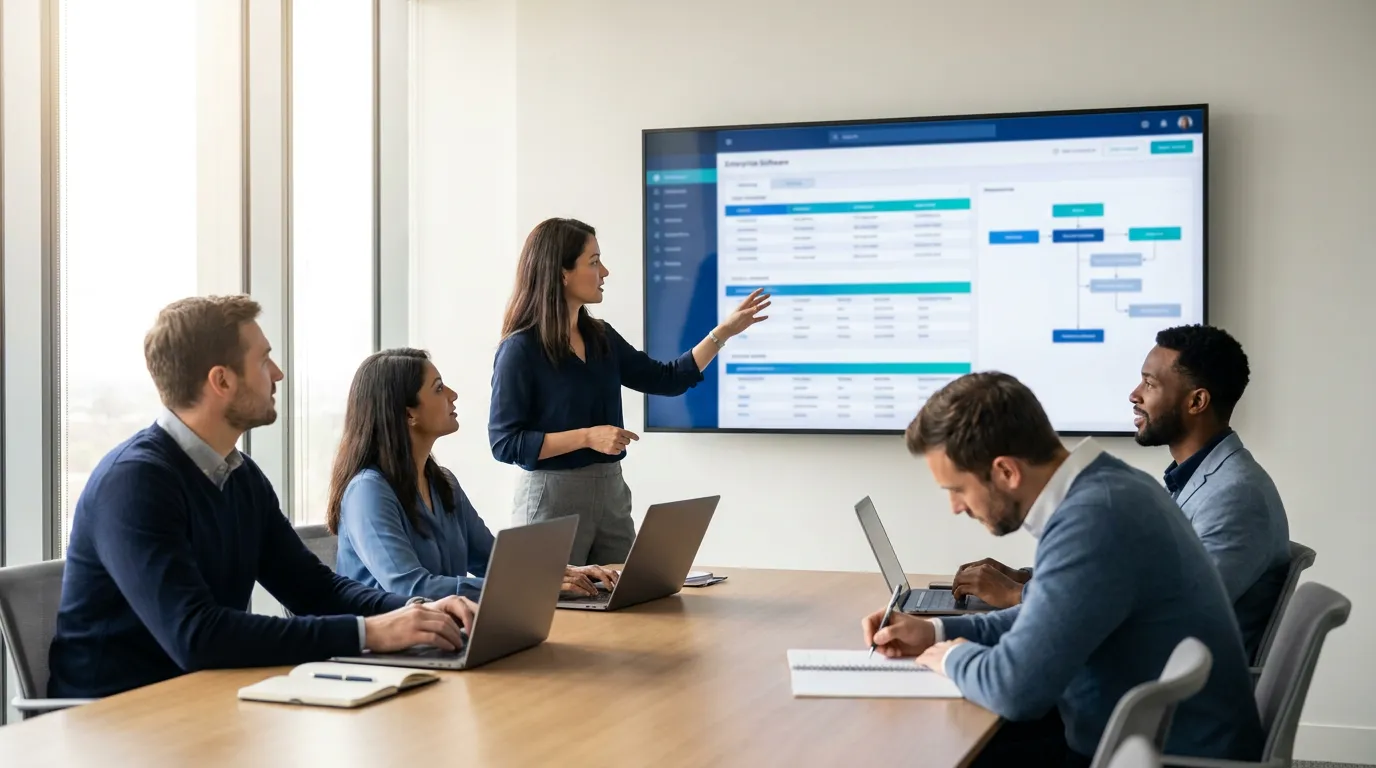
Train-the-Trainer: Power users from the business units work together with the consultants in the system from the outset and later train their own teams. Image: AI-generated.
Based on our project experience, the most difficult challenge in an ERP implementation is rarely the technology itself, but rather change management. Employees are expected to adopt a new platform, new processes, and a new user interface. Some go along with it, some take a wait-and-see approach, and there are critics and naysayers. We hear from many companies that this—and not the software itself—is where the real hurdle lies. This work cannot be outsourced. It must run as a separate, in-house initiative in parallel with the project. We support and empower the power users, who are introduced to the system from the very beginning and then train their own teams. This creates advocates early on. The initiative must come from the client’s side: Those who fill this role early on have one less risk factor to contend with.
The go-live took place right on schedule on January 1, 2026, and the final data migration was successful. During the hypercare phase, we resolved the remaining issues and enabled the organization to work with the system to its full extent. The company gained the following from the project:
Go-live on schedule on January 1, 2026, eleven months after the contract was awarded
All end-to-end processes, including interfaces and peripheral systems, are within the scope
Two business models in one system: custom manufacturing and development
Integration with Microsoft Dynamics 365 Sales in virtually all processes
The final data migration for the go-live was successful
Power Users Established as Coaches for Their Own Teams
Structured and documented knowledge about Azure DevOps and ICB IGNITE
The Germany template as the basis for the rollout to other locations
Go-live on January 1, 2026, eleven months after the contract was awarded—including all end-to-end processes, interfaces, and peripheral systems.
The early start to the master data migration and the implementation of the standard system enabled the business units to begin productive work quickly.
Consistent end-to-end processes, resulting in more stable workflows. Knowledge is structured and documented through Azure DevOps and ICB IGNITE.
The Germany template serves as the basis for the rollout. This means that other locations do not need to be designed from scratch.
This success story describes a real-life consulting project in anonymized form. To protect the client, neither company nor individual names, nor the industry, location names, or the manufacturer of the legacy system are mentioned; the background information provided is intentionally kept general. The photorealistic page images are AI-generated, and the phase diagram is our own illustration.
